

Search Results

8 October, 2026
What Two Decades Of Building Teams Taught Me About Feedback
What Two Decades Of Building Teams Taught Me About Feedback
If you're new to a role, or trying to build a team that will actually tell you the truth, feedback is one of the fastest ways to learn what's working and what isn't. The trouble was never wanting it, it's asking for it in a way that gets you something more useful than a polite non-answer.
Ask someone "how am I doing?" and watch what happens. Most times you'll get a shrug, a smile, or "yeah, all good," not because everything is actually fine, but because you've just put someone on the spot and most people take the easy way out.
I started my first promotional products business back in 2000, and I've built and handed over a few since then. The standoff never really changes, and I've come to think feedback isn't hard to give because people are dishonest. It's hard because honesty carries a cost, and most people would rather keep the peace than pay it.
Feedback Is A Trust Exercise, Not A Confidence One
Asking for feedback gets talked about as a confidence move, but in my experience it's really a trust test. The second you ask, you hand the other person a decision: tell you what they actually think, or protect the relationship and say something safe.
A Vague Question Gets A Vague Answer
"How am I doing?" asks someone to compress weeks of observations into a single line, which is an unreasonable request, so you tend to get an unreasonable answer back: something reassuring, forgettable, and no use to anyone.
If you're new to a team, this matters even more, because you haven't yet built up the track record that lets people speak plainly with you. A vague question just gives them another reason to stay vague back.
Shrink The Question Down To One Thing
The fix is to point at something specific, whether that's a quote you sent out, a call with a supplier, a pitch to a new client, or a packing run that went out the door that afternoon. The narrower the target, the sharper the answer tends to be.
This holds as true in a warehouse as it does in a boardroom. Ask someone about "your work" in general and they'll freeze, but ask about one job from last Tuesday and they'll usually have something real to say.
Say What You Want Looked At
Even a specific piece of work can still get a vague answer if you don't say what you want assessed. Was the tone right on that call? Did the quote come back too slowly? Did the sample match the brief?
Naming the dimension gives the other person permission to focus on one thing, rather than scanning for everything that might be worth mentioning and picking the safest one to say out loud.

Timing Beats Politeness
Feedback has a use-by date, and asking a week later tends to get you a tidied-up, half-remembered account of what happened rather than the real one you'd get by asking on the day.
I would rather have an honest reaction while the work is still warm than a polished version of it at the next scheduled review.
Make It Easy To Say No
The more pressure someone feels to answer, the less useful the answer becomes. A simple line, something like "happy to come back to this later if now's not the right time," does more for honesty than any amount of encouraging someone to "be brutally honest."
Pressure tends to get you politeness, while giving someone room tends to get you the truth.
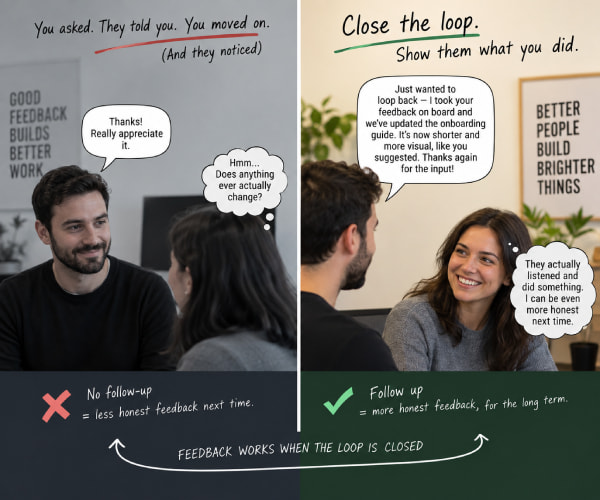
Close The Loop, Or Don't Bother Asking
This is the step almost everyone skips. Someone gives you feedback, you say thanks, and you move on with your day, and next time you ask, they remember that nothing changed and give you less.
Go back and tell them what you actually did with what they said. Even a short message shows it landed somewhere, and that's what makes someone willing to be straight with you the second time, and the twentieth.
Specific Feedback Still Needs A Filter
Getting a specific, honest answer doesn't mean you have to act on all of it, because sometimes what comes back is one person's read on a single moment rather than a pattern worth chasing.
The discipline is in asking properly, not in agreeing with everything you hear back. I still weigh a specific answer against what I already know about the job and the person giving it before deciding what to change.
Feedback Habits Don't Scale Themselves
What works with three people around a table doesn't automatically work with thirty, especially once part of that team is a factory floor on the other side of the world turning out over a million lanyards a month. That gap taught me the habit has to be trained in on purpose, because left alone, teams default back to "yeah, all good."
If you want honest feedback running through a growing business, it has to be built into how people are managed day to day, rather than left as something that happens only if a manager remembers to ask nicely.

The Same Habits Work On Customers
We run the same approach outward, not just inward. If a customer flags that a print run on a batch of stubby holders came out slightly off, or that a sample from the eco-friendly range didn't land the way they expected, that's specific and timely, and exactly the sort of feedback worth acting on straight away.
A specific complaint about one order tells us more about where our quality control needs attention than a general survey ever could, because it's the same discipline either way: one thing, named clearly, raised while it's fresh.
Asking Too Often Undoes The Trust You're Building
The same approach that makes feedback useful can tip into something else if it happens after every single job, because people start performing an answer instead of giving one when they can tell you're checking rather than asking.
It works best saved for the moments where the answer would actually change what happens next, rather than turned into a habit that follows every interaction.
Getting Used to Feedback
None of this is complicated. It comes down to picking one thing, saying what you want looked at, asking while it's fresh, making it easy to decline, and following up on what changed.
Do that consistently, over enough years and across enough teams, and you end up with people who tell you the truth instead of what they think you want to hear. That's worth more than any performance review ever built, and it costs nothing but the discipline to ask properly.
The PromotionsOnly Team